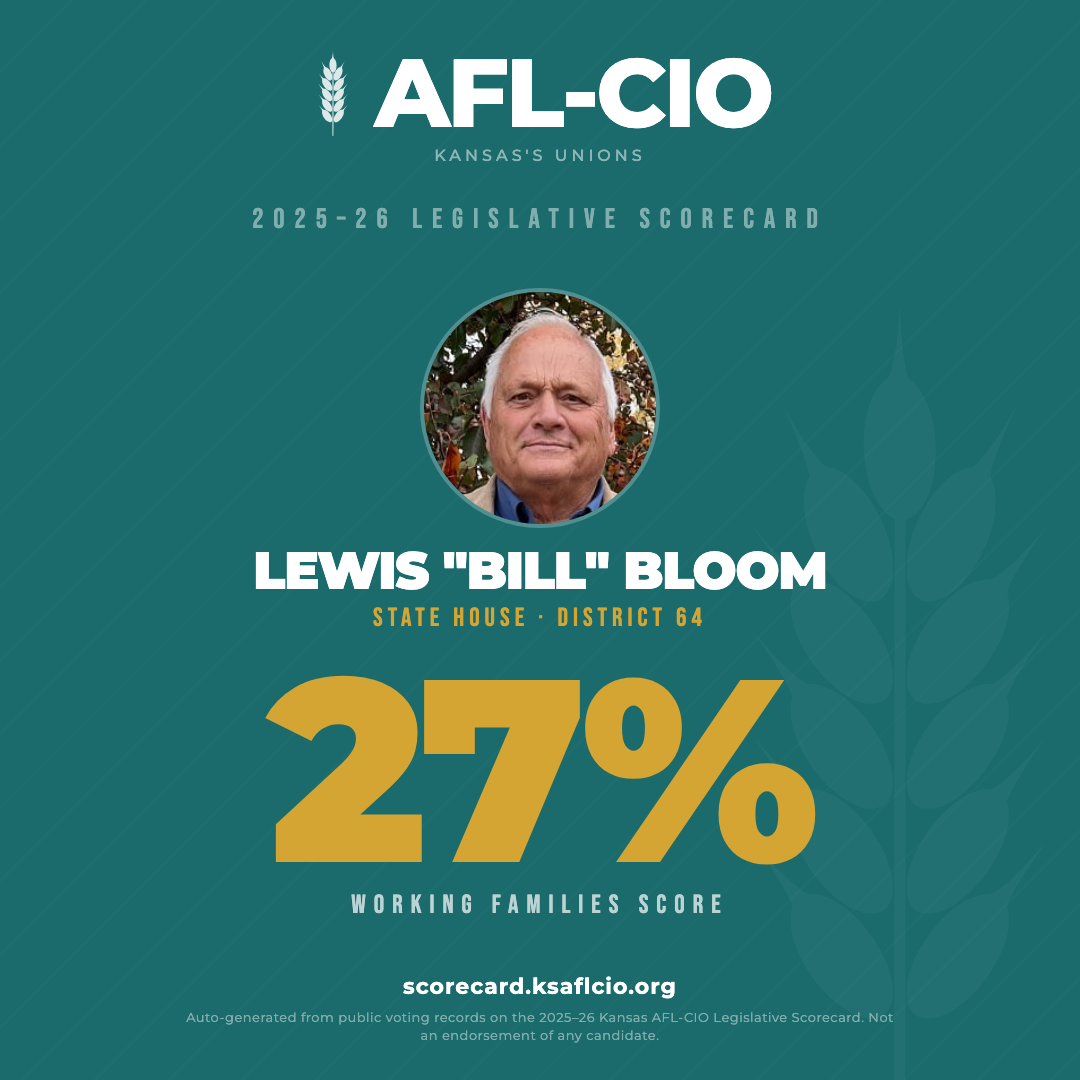
Lewis "Bill" Bloom
Republican
House · District 64
Session Score
Party Average
Lifetime Score
16
Voted with working people
51
Voted against working people
0
Did not vote
Out of 67 key votes
Voted with working people
Voted against working people
Did not vote
Key Votes
Voted Against Working People
SB 391 permanently blocks Kansas cities and counties from passing local ordinances that protect renters — including rules limiting landlords' use of criminal history, credit scores, and eviction records to screen tenants. The bill uses the same state preemption playbook that already stripped local governments of the power to set their own minimum wage. For union members with records who got back to work through fair chance hiring, this law slams the door on local fair chance housing protections that could help them stay housed.

This bill expands SNAP work requirements to cover workers up to age 64, strips food assistance exemptions for veterans and homeless individuals, and permanently blocks the Governor from restoring those protections during a recession without an act of the legislature. Workers aged 50-64 who lose their jobs — especially those in physically demanding trades — face a three-month cutoff on food assistance even when age discrimination and injury make finding new work difficult. Labor opposes this veto override because it punishes workers in legitimate job transitions and removes a critical safety net tool during economic downturns.
This bill blocks workers from recovering damages in negligence cases if they were engaged in any "wrongful conduct" — a definition broad enough to sweep in undocumented workers injured on the job in meatpacking, construction, and agriculture. It also shields product manufacturers from public nuisance lawsuits and gives the Attorney General sole control over multi-county claims like PFAS contamination cases that firefighter locals are pursuing nationally. The law applies retroactively to pending cases, killing active lawsuits against polluters and other bad actors as of July 1, 2026.
SB 30 requires full legislative approval before any state agency can create or strengthen occupational licensing standards for trades like electrical, plumbing, and HVAC — while exempting doctors, nurses, and dentists. The bill forces agencies to prove that mandatory licensing is the "least restrictive" option, opening the door to replacing proven apprenticeship-based licensing with weaker voluntary certification. This threatens the apprenticeship pipelines and wage floors that building trades workers have built over decades. The legislature voted to override the Governor's veto.
This bill makes it a criminal misdemeanor to operate a voter registration website without a .gov domain or personal approval from the Secretary of State — directly threatening the online voter registration drives that unions and civic organizations routinely run for their members. It also requires state agencies to report personal information of noncitizen public assistance recipients to the Secretary of State, creating a chilling effect on benefit access for immigrant workers in meatpacking, food processing, and other union-represented industries. The Legislature voted to override the Governor's veto and enact the bill into law.
This omnibus bill raises the age limit for strict SNAP work requirements from 49 to 64, meaning workers in their 50s and early 60s who lose a job could lose food assistance after just three months. It also strips exemptions for veterans, homeless individuals, and former foster youth, and prohibits the Governor from waiving work requirements during a recession without a vote of the full legislature. Workers in physically demanding trades who face longer job searches as they age would be hit hardest.
This conference committee report gutted a healthcare bill and replaced it with the contents of HB 2448, requiring citizenship status to be printed on Kansas driver's licenses. Because driver's licenses are routinely presented during employment verification and workplace interactions, this creates a government-issued marker that makes immigrant workers — including union members in Kansas meatpacking, construction, and agriculture — more visible targets for employer intimidation and less likely to report safety violations, file wage claims, or participate in union organizing.
This bill lets just 10% of registered voters sign a petition to freeze local government and school district budgets at prior-year levels, blocking tax revenue increases above inflation plus 3%. The petition mechanism includes no protection for wages and benefits already negotiated in collective bargaining agreements, meaning a successful petition could prevent a school district or city from funding raises it already agreed to pay teachers, public employees, and other union workers. The bill also provides government-funded petition infrastructure by embedding signature pages in tax notices mailed to every property owner.
SB 361 opts Kansas into a federal tax credit program that subsidizes private school scholarships, diverting students and funding away from public schools where thousands of union members work as teachers, paraprofessionals, custodians, and food service workers. The bill also permanently bars any state agency from setting worker protections or accountability standards for participating private schools that go beyond the minimal federal floor. Less funding for public schools means fewer jobs, weaker bargaining power, and lower standards for education workers across Kansas.
This bill eliminates mandatory fire sprinkler systems in new townhouse construction of four units or fewer and prohibits cities and counties from requiring them locally. It directly reduces work hours for UA sprinkler fitters who install these systems, removing a key source of building trades employment in residential construction. The bill also strips local governments of the authority to set their own fire safety standards — the same preemption approach used to block local wage protections.
This bill creates a voluntary "portable benefit plan" for independent contractors but includes a critical provision that prevents benefit contributions from ever being used as evidence that a worker is actually an employee. That legal shield lets gig companies like Uber and DoorDash make token benefit contributions while permanently blocking workers from using those contributions to prove they deserve full employee protections — including wages, workers' comp, unemployment insurance, and the right to organize. The benefit framework itself has no minimum contribution requirements and no mandate for companies to participate.
This massive rewrite of Kansas unemployment insurance law touched dozens of provisions governing who qualifies for benefits, how long they last, and what counts as "suitable work." While early versions contained real wins for workers — including protections against midnight budget cuts to UI and guarantees that union-negotiated supplemental unemployment pay wouldn't reduce state benefits — the final version that came out of conference committee drew unanimous opposition from Democrats, signaling that critical worker protections were gutted or that harmful restrictions on eligibility and benefits were added. Labor opposes the bill as passed because the final product failed to protect the provisions that mattered most to working families who depend on unemployment insurance during layoffs.
This bill creates a new exception to Kansas law that previously banned prison-made homes from competing with construction workers and manufactured home builders. While contractors must pay regional average wages, that money goes to the state — not the incarcerated workers doing the job — giving contractors a workforce that can't quit, organize, or file safety complaints. The bill undermines building trades workers by allowing a private company to use prison labor for home construction at the Hutchinson correctional facility, setting a dangerous precedent that could expand beyond this pilot program.
This bill requires cities and counties to get the Attorney General's approval before hiring lawyers on contingency to sue corporations — for example, over pollution, unsafe products, or other harms to communities. By giving the AG veto power over these contracts, it makes it harder for local governments to hold corporations accountable when they harm workers and their families. Labor opposes this bill because it strips communities of an essential legal tool to fight back against corporate wrongdoing.
This bill requires the Department of Insurance to produce cost reports on health coverage bills — but the reports only count premium increases, not the savings workers get from better coverage. Even worse, the underlying data submitted by insurance companies is kept secret from the public, making the reports impossible to verify or challenge. The result is a tool that can be used session after session to kill coverage mandates that protect working families' health benefits.
This bill eliminates mandatory fire sprinkler installation in new townhouse construction of four units or fewer and bars cities and counties from requiring sprinklers on their own. It directly reduces work hours for UA sprinkler fitters who install these systems, while removing a key fire safety protection for Kansas families. The bill also sets a troubling precedent by using state law to override local building and safety standards — the same preemption strategy that has been used to block local wage protections.
HB 2503 repeals the Kansas Mail Ballot Election Act, eliminating the option for local governments to conduct special elections — like school bonds, annexations, and water district questions — by mail. These are the very elections that determine funding for public services and infrastructure where union members work. Ending mail ballots for these elections creates real barriers for workers on rotating shifts, overnight schedules, or 12-hour days who can't easily get to a polling place on a Tuesday.
This bill restricts restroom and locker room access in all public buildings based on sex assigned at birth, imposing fines and criminal misdemeanor charges on workers who don't comply. It directly affects transgender public employees — including teachers, state workers, and municipal employees — by threatening them with arrest for using workplace restrooms. The law also forces changes to driver's licenses and birth certificates, disrupting identity documents workers need for employment verification, and redefines "gender" across all Kansas law in ways that could weaken workplace discrimination protections.
This bill requires the Secretary of State to check voter registration rolls against a federal immigration database (SAVE) twice a year and remove voters flagged as potential non-citizens. Voter purge programs like this have a well-documented history of incorrectly flagging eligible citizens — particularly naturalized citizens, working-class voters, and communities of color — leading to wrongful removal from the rolls. Labor opposes this bill because it creates unnecessary barriers to voting for the very working families and union members who depend on their voice at the ballot box.
This bill creates a voluntary "portable benefits" framework for independent contractors working for gig companies like Uber and DoorDash, but its real impact is a legal shield buried in the fine print: companies that make even token contributions to a worker's benefit account can't have those contributions used as evidence that the worker is actually an employee. That matters because when workers are misclassified as independent contractors, they lose access to minimum wage protections, overtime, workers' comp, unemployment insurance, and the right to organize. By severing this key legal link, the bill makes it harder for misclassified workers to prove they deserve full employee rights and benefits.
HB 2504 prohibits cities and counties from passing local laws that protect renters who use housing vouchers or have criminal or eviction histories. The bill strips local governments of the power to require landlords to give these tenants a fair chance at housing — undermining the same fair-chance principles labor has fought for in hiring. This hurts working families trying to find stable housing, especially low-wage workers and those rebuilding their lives after incarceration.
HB 2453 cuts off in-person advance voting before election week, moves the voter registration deadline to 25 days before the election, and requires mail ballot applications 14 days earlier. These restrictions hit shift workers, hourly employees, and newly organized members hardest — the very people who rely on weekend voting and late registration because their work schedules don't allow flexibility. The bill also compresses the window unions use for worksite voter registration drives ahead of elections.
This bill makes it a criminal misdemeanor for public employees to use any government resources — including work time — to communicate about constitutional amendments or ballot questions. It removes an existing legal safe harbor that allowed public workers to respond to citizen inquiries and share neutral information, leaving school communications staff, city clerks, and agency employees exposed to prosecution for routine job duties. The bill also imposes new restrictions on how local governments can inform voters about bond issues, making it harder for school districts and cities to explain construction bond proposals — threatening the publicly funded building projects that put trades workers on the job.
This bill gives special legal protections to anti-abortion pregnancy centers, including an explicit provision allowing them to fire or refuse to hire workers who don't agree with the center's mission. It also blocks cities and counties from regulating these centers' staffing or operations, preempting local authority. Labor opposes because the bill carves out a legal right to discriminate against workers based on personal beliefs and strips local governments of their ability to set workplace standards.
This bill forces state agencies to collect detailed personal information — including alien registration numbers, Social Security digits, and home addresses — of noncitizen public benefit recipients and report it quarterly to the Secretary of State. It will discourage immigrant workers in meatpacking, agriculture, and construction from filing workers' comp and unemployment claims they've legally earned, making them more vulnerable to exploitation on the job. It also burdens public-sector state employees with an unfunded surveillance mandate and no data security protections.
This conference committee report subjects all new occupational licensing requirements to legislative approval and automatically sunsets every existing agency-adopted licensing requirement by July 2030 unless the legislature affirmatively renews each one. Workers who invested years and thousands of dollars earning credentials in trades, cosmetology, and other licensed occupations face the real prospect that their licensing standards simply vanish through legislative inaction or gridlock. The bill strategically exempts the six most politically powerful health licensing boards — nursing, pharmacy, dental, healing arts — while leaving less politically connected working-class occupations exposed.
This bill requires "NONCITIZEN" to be printed on the driver's licenses of lawfully present green card holders, visa workers, and other immigrants. Because driver's licenses are used for employment verification and everyday workplace identification, this marks immigrant workers — many of whom are union members in Kansas meatpacking and agriculture — in ways that make them more vulnerable to employer intimidation and less likely to report safety violations, wage theft, or participate in organizing.
Rep. Boatman's amendment would have kept the Kansas private school scholarship tax credit cap at $10 million and removed the automatic escalator that allows the cap to grow to $30 million without further legislative action. Kansas public schools employ tens of thousands of union-represented teachers, paraprofessionals, custodians, and support staff whose wages and working conditions depend on adequate state funding — and the state already faces a $228 million special education funding shortfall. Every dollar diverted through expanded tax credits is revenue the State General Fund does not collect, increasing pressure on the public school budgets that fund union jobs. The amendment was rejected 35-82, clearing the way for the bill to double the cap and add the automatic escalator on final passage the following day.
This bill requires any website used for voter registration to either have a .gov domain or get pre-approval from the Secretary of State, with violations carrying criminal misdemeanor charges. Unions and community organizations that run voter registration drives could be shut out of online registration if the Secretary of State denies or delays approval — and the bill includes no timeline, appeal process, or objective standards for those decisions. The result is a new layer of government gatekeeping over civic engagement tools that labor and allied organizations rely on to register working people to vote.
SB 254 bars undocumented immigrants from state and local public benefits, voids Kansas's in-state tuition law, and creates a presumption that noncitizens charged with any crime are a flight risk who can be held without bond. The bill chills workplace safety complaints and wage theft reporting by immigrant workers in meatpacking and construction — making job sites less safe for all workers — while imposing unfunded verification duties on state and county employees who administer benefits programs. A NAY vote protects workers' ability to report unsafe conditions and prevents an unfunded mandate on public employees.
This bill says that if a pesticide carries an EPA-approved federal label, that's good enough to shield the manufacturer from state lawsuits over failure to warn about health risks. In practice, it takes away the main legal tool that farmworkers, groundskeepers, and other workers exposed to pesticides on the job have used to hold chemical companies accountable when they get sick. The bill goes beyond what federal law requires and eliminates state tort claims that have been workers' last resort — especially for agricultural workers who already have the fewest workplace protections.
SB 244 restricts restroom access in public buildings based on biological sex at birth, imposing criminal penalties — including misdemeanor charges — on workers who violate the policy. It also forces reissuance of driver's licenses and birth certificates, disrupting identity documents that workers need for employment verification. This amendment would have addressed the bill's harshest provisions, but it failed. Labor supported the amendment because the underlying bill creates a hostile work environment for public employees, exposes union members to criminal penalties for using workplace facilities, and redefines "gender" across Kansas law in ways that could weaken employment discrimination protections.
This bill makes it a crime for transgender public employees to use restrooms matching their gender identity at their own workplaces, with escalating fines and misdemeanor charges. It also forcibly invalidates driver's licenses and birth certificates, disrupting the identity documents workers need for employment verification. The law creates a private lawsuit mechanism that allows coworkers to sue transgender employees for using workplace facilities, and redefines "gender" across all Kansas statutes in ways that could weaken employment discrimination protections for years to come.
SCR 1604 asks Congress to call a convention to amend the U.S. Constitution with the goal of limiting federal government power. Federal authority is the legal foundation for the National Labor Relations Act, the Fair Labor Standards Act, OSHA, and other bedrock worker protections — a constitutional convention could open the door to weakening or eliminating any of them. Labor opposes this resolution because the risk to working families' rights is too great.
HB 2289 phases out Kansas's affordable housing tax credit by eliminating credits for 4% federal tax credit projects immediately, capping annual awards, and sunsetting the entire program after 2028. This credit drives affordable housing construction across Kansas, supporting good-paying construction jobs and creating homes working families can afford. Ending the program means fewer projects getting built, fewer jobs for building trades workers, and less affordable housing in communities that desperately need it.
SB 82's conference committee report — gutted from a rural hospitals bill on the session's final day with no public hearing — would have capped local government property tax revenue growth at 3% annually and required an extraordinary 80% supermajority of any governing body to exceed it, meaning a single dissenter on a five-member county commission could block revenue needed to fund negotiated wage agreements, fill vacant positions, or keep pace with health insurance costs that routinely rise 6-10% per year. The bill's ASTRA Fund went further, stripping state funding from any jurisdiction that even held a vote on exceeding the cap — penalizing the act of democratic deliberation itself. Because personnel costs represent 60-80% of city and county budgets, this cap directly threatened the wages, benefits, and jobs of thousands of union-represented firefighters, law enforcement officers, public works crews, and county employees across Kansas. The House adopted the report 74-48, though the bill died when the Senate adjourned without voting on it.
SB 269 locks Kansas into an automatic system that ratchets down income tax rates whenever revenues exceed a formula-based threshold. While the bill includes some fiscal guardrails, every triggered rate cut permanently reduces the revenue available to fund public schools, state agencies, and KPERS retirement contributions that working families depend on. The bill also immediately raised effective tax rates on lower-income Kansans by collapsing three tax brackets into two, hitting workers earning under $30,000 the hardest.
This bill removes longstanding legal protections for 401(k)s, IRAs, and other retirement accounts from child support claims, and allows courts to order full liquidation of those accounts — with workers paying early withdrawal penalties and taxes on top. The bill's vague "voluntary underemployment" trigger, which activates the retirement seizure power, is never defined and could potentially reach workers who go on strike, take FMLA leave, or accept a union-negotiated buyout. Workers who spent years building retirement security through collectively bargained benefits could see those accounts drained, losing far more in penalties and taxes than the support obligation satisfied.
This bill requires legislative approval before any state agency can seek federal waivers to expand Medicaid eligibility or make changes to services for people with intellectual and developmental disabilities. It creates a major barrier to federal funding that could raise wages for Kansas's roughly 10,000 direct support professionals — chronically underpaid workers who provide daily care to some of our most vulnerable neighbors. By adding political hurdles to routine federal waiver requests, this law makes it harder for the state to bring home federal dollars that support healthcare jobs and working families' access to care.
SB 14 creates a "continuous budget" that keeps last year's spending levels in place if the legislature doesn't pass a new budget, eliminating the governor's ability to use a budget impasse to push for better pay, benefits, and funding for workers' programs. Even more concerning, it gives the Secretary of Administration power to automatically cut state funding for Medicaid, workforce programs, and social services whenever federal dollars are reduced — bypassing the legislature where working families have a voice. Labor opposed the veto override because this bill shifts budget power away from the democratic process and puts public sector jobs and critical services at risk of cuts by unelected administrators.
HB 2291 creates a "regulatory sandbox" program that allows businesses to apply to have state rules and regulations suspended — including potentially workplace safety and wage protections enforced by the Kansas Department of Labor. The program is overseen by a business-dominated advisory committee with no labor representation, applications are kept secret from the public, and if an agency fails to respond within 30 days, rules are automatically waived. Labor opposed this bill because it undermines the regulations that protect working people on the job, with no transparency or worker voice in the process.
This bill gives the Attorney General's inspector general sweeping new powers — including subpoenas, search warrants, and criminal jurisdiction — to investigate families who receive food assistance (SNAP), cash assistance (TANF), and Medicaid. Many union members in lower-wage jobs rely on these programs to make ends meet, and healthcare and social service workers at Medicaid-participating facilities could be compelled to turn over records or testify against their own employers. Labor opposes this bill because it builds a coercive enforcement apparatus targeting working families who depend on the safety net, while doing little to hold large contractors accountable.
This bill removes the authority of local health officers to prohibit public gatherings during infectious disease outbreaks, downgrading that power to a non-binding recommendation. For nurses, meat-processing workers, corrections officers, and other frontline employees, this eliminates a critical legal backstop — when a health officer could only "recommend" against gatherings, workers who stay home to protect themselves have no legal protection from being fired. The veto override vote stripped away public health enforcement tools that essential workers depend on during emergencies.
HB 2311 prohibits the Kansas Department for Children and Families from considering a prospective foster or adoptive parent's beliefs about sexual orientation or gender identity when making placement decisions, even when a child's wellbeing may be at stake. The bill overrides the professional judgment of DCF caseworkers and exposes the agency to lawsuits, creating new legal liability for the department and its workers. Labor opposes this bill because it undermines the ability of public sector employees to do their jobs and prioritize the best interests of children in state care.
This bill expands the Kansas Promise Scholarship — which helps working families afford career and technical education — to include a new category of institutions that drops the nonprofit requirement. While the funding increase is welcome, this change could divert millions in public workforce training dollars to for-profit career schools with track records of poor job placement and predatory recruitment targeting the same working-class families the program is designed to help. Labor opposes this bill because public investment in workforce development should flow to institutions with proven outcomes for workers, not to those whose business model depends on exploiting them.
SB 241 rewrites Kansas law to make employer non-solicitation agreements "conclusively presumed enforceable" against workers — with no income floor — flipping the burden so employees must hire a lawyer and go to court to challenge restrictions on where they can work. The bill also strips judges of the power to throw out overreaching agreements, instead requiring courts to save them by trimming them down, removing any incentive for employers to write fair contracts. The broad language covering anyone who "interferes with the employment relationship" could even be used to threaten former employees who help their old coworkers organize a union.
This bill bars state agencies from requiring college degrees for most government jobs and promotions, replacing them with experience-based criteria. While skills-based hiring sounds good on paper, state employee unions raised serious concerns that removing degree requirements without safeguards could lead to wage compression, downgrading of job classifications, and lower pay for experienced workers. The bill also lacks any enforcement mechanism, leaving state workers with no way to hold agencies accountable if they misapply the law.
This bill transfers the state employee health benefits program to the Insurance Department — a reasonable reorganization on its face. But buried in the fine print, it deletes injured workers' right to have their attorney notified when workers' comp payments are made electronically, repeals ten statutes governing employer contributions for state employees' children's health coverage, and hands permanent control of the state employee health care commission to the elected Commissioner of Insurance rather than a governor's appointee accountable to state workers. These hidden rollbacks were never debated as standalone bills and directly harm the roughly 40,000 state employees and their families who depend on these programs.
This constitutional amendment would let the legislature revoke any state regulation — including workplace safety rules, workers' comp standards, and wage enforcement procedures — through a simple concurrent resolution that the governor cannot veto. A catch-all provision allowing revocation whenever the legislature decides a rule is "not beneficial to the public good" gives lawmakers unlimited power to gut protections with no executive branch check. Because it amends the constitution, this change would be permanent and could not be reversed by a future governor or legislature without another statewide vote.
This bill bans gender transition care for minors, but buried in its enforcement provisions are direct attacks on workers: it strips healthcare workers of malpractice insurance coverage, mandates automatic license revocation with no professional board discretion, and restricts what state employees can say on the job. The legislature voted to override the Governor's veto, exposing nurses, doctors, and state workers in SEIU and AFSCME bargaining units to career-ending liability with no due process protections. A NAY vote sustained the Governor's veto and protected workers.
SB 63 bans gender transition care for minors, but buried in the bill are provisions that directly hit healthcare workers: automatic license revocation with no professional board discretion, a ban on malpractice insurance covering affected providers, and strict personal liability lasting a decade. It also restricts what state employees — including social workers and hospital staff — can say on the job using vague, undefined terms. Labor opposes this bill because it strips workers of due process protections, eliminates insurance coverage, and exposes union members in hospitals, clinics, and state agencies to career-ending punishment without the safeguards that professional licensing boards are supposed to provide.
Voted With Working People
This proposed constitutional amendment would allow the legislature to revoke any state regulation — including workplace safety rules, workers' comp standards, and labor enforcement procedures — through a simple concurrent resolution that the governor cannot veto. The catch-all provision letting legislators strike down any rule "not beneficial to the public good" in their "sole discretion" puts every worker protection adopted by state agencies permanently at risk. The concurrence vote failed 59-62, blocking this amendment from reaching the ballot.

SB 361 opts Kansas into a federal tax credit program that subsidizes private school scholarships, diverting students — and the per-pupil funding that follows them — away from public schools where thousands of union members work as teachers, paraprofessionals, bus drivers, and support staff. The bill also permanently bars any state agency from setting worker protections or accountability standards stronger than the federal minimum for participating private schools. Labor urged legislators to sustain the Governor's veto and protect public school funding and the workers who depend on it.
The conference committee report on HB 2513 became the omnibus state budget after conferees gutted the original claims bill and replaced it entirely. The final budget included only a 1% across-the-board salary increase for roughly 35,000 executive branch and Kansas Board of Regents university employees — despite Governor Kelly recommending 2.5% and a 2025 market salary study showing state workers falling further behind. Meanwhile, legislators had already awarded themselves an automatic 4% raise indexed to average wage growth and given their own professional staff 10% increases. Senate Minority Leader Dinah Sykes called the 1% offer a slap in the face. The budget also imposed 1.5% cuts across 24 state agencies while projecting depletion of 1.1 billion in reserves over three years. A NAY vote supported demanding meaningful investment in the state workforce that keeps Kansas running.
This biennial state budget set spending levels for all state agencies but included zero pay raises for the roughly 40,000 Kansas state employees, despite a market salary study showing workers falling further behind. The budget also directed conference committee negotiations on a pay plan but failed to guarantee any outcome, while containing provisions that weakened job security for university workers. A NAY vote supported sending the budget back for meaningful investment in the state workforce.
This bill lets just 10% of registered voters in a community block local governments and school districts from raising property tax revenue — even when increases are needed to fund negotiated wage agreements. Protest petition forms would be mailed directly to every property owner at taxpayer expense, giving anti-tax groups a powerful new tool to squeeze the budgets that pay public employees. There is no protection for existing union contracts, meaning a successful petition could make it impossible for employers to fund already-negotiated raises for teachers, firefighters, and other public workers.
This amendment to the state budget would have directed $40.6 million to special education, drawing first from unspent federal ARPA funds already allocated to Kansas. State law requires 92% reimbursement of special education costs, but Kansas has funded only 70-75% for years — a shortfall that forces school districts to increase caseloads, cut support staff positions, and suppress wages for the thousands of teachers, paraprofessionals, and therapists who deliver these services. The amendment represented less than four-tenths of one percent of the state general fund budget.
This bill requires that any lawsuit challenging the constitutionality of a Kansas election law must be filed in Shawnee County district court, rather than in a voter's home district. By funneling all election-related cases to a single courthouse in Topeka, the bill makes it harder and more expensive for everyday Kansans — including working families — to challenge laws that restrict voting access. Workers depend on accessible elections to protect their economic interests, and this bill creates new barriers to holding lawmakers accountable when they pass unconstitutional election restrictions.
This bill creates statewide electrician licensing with an 8,000-hour experience requirement for journeyman electricians — a standard that matches union apprenticeship programs — and explicitly recognizes completion of a U.S. Department of Labor registered apprenticeship as a qualification for licensure. It replaces the old patchwork of city and county licensing with a single portable state license, ensuring consistent quality standards and making it easier for skilled electricians to work across Kansas. A YEA vote supports strong training standards that protect both workers and consumers.
This bill requires the Kansas Department of Health and Environment to create rules by 2028 allowing communities to treat wastewater for use as drinking water. Expanding water reuse infrastructure means construction jobs and long-term water security for Kansas communities, particularly in western Kansas where water shortages threaten local economies and the workers who depend on them. The bill also includes affordability safeguards so smaller communities aren't priced out of compliance.
This bill doubles the tax credit cap for donations to private school scholarship programs from $10 million to $20 million and opts Kansas into a new federal tax credit that lets wealthy individual donors stack additional subsidies on top. By diverting more public dollars to private schools that lack union protections and collective bargaining, this bill threatens funding, jobs, and bargaining power for public school employees — including teachers and support staff who are union members.
This bill requires Kansas school districts to show a computer-generated animation or ultrasound of fetal development in any course covering human growth, development, or sexuality — with no input from teachers or education professionals on how it fits into existing curriculum. Labor opposes this bill because it overrides the professional judgment of educators, dictating specific classroom content by legislative mandate rather than trusting trained teachers and local school boards to make sound curriculum decisions. This kind of top-down mandate undermines educators' working conditions and professional autonomy.
This bill doubles the amount individuals and political committees can contribute to candidates at every level — from $500 to $1,000 for state House races, and from $2,000 to $4,000 for statewide offices. It also eliminates caps on contributions to party committees entirely. Raising contribution limits amplifies the influence of wealthy donors and corporate interests, diluting the political voice of working families and unions who rely on grassroots organizing and small-dollar fundraising to compete.
HB 2160 creates the Kansas Municipal Employee Whistleblower Act, making it illegal for supervisors to fire, demote, suspend, or retaliate against city, county, and school district employees who report unlawful or dangerous conduct. Workers can report problems to any person or agency — including their union, the press, or law enforcement — without first going through their boss. This law directly protects AFSCME, IAFF, IBEW, and Teamsters members working in public service, giving them a legal right to speak up about corruption, safety hazards, and misuse of public funds without fear of losing their jobs.
This bill requires drivers to slow down and, when possible, move over a lane when passing any stopped vehicle displaying hazard lights, flares, or warning cones. Current Kansas law only requires this for emergency vehicles — SB 8 extends that protection to utility workers, truck drivers, road crews, and anyone else stopped on the shoulder. This is a common-sense safety measure that directly protects Teamsters, IBEW lineworkers, Operating Engineers, and other union members who regularly work alongside traffic.
This bill creates the Kansas Municipal Employee Whistleblower Act, making it illegal for supervisors to fire, demote, suspend, or retaliate against city, county, and school district employees who report unlawful or dangerous conduct. Workers can report problems to anyone — the media, a state agency, or their union — without first going through their boss. This is a direct win for AFSCME, IAFF, IBEW, and Teamsters members in public employment, giving them real legal protections when they speak up about corruption, safety hazards, or misuse of public money.
HB 2086 improves the retirement dividend formula for every Kansas public employee hired since 2015 — including teachers, state workers, and local government employees. It lowers the investment return threshold from 6% to 5% and increases workers' share of excess returns from 75% to 80%, effectively more than doubling the annual dividend credit in typical years. This is a straightforward improvement to the deferred wages our members earn, and it passed the House 116-5 with broad bipartisan support.
Share This Scorecard